


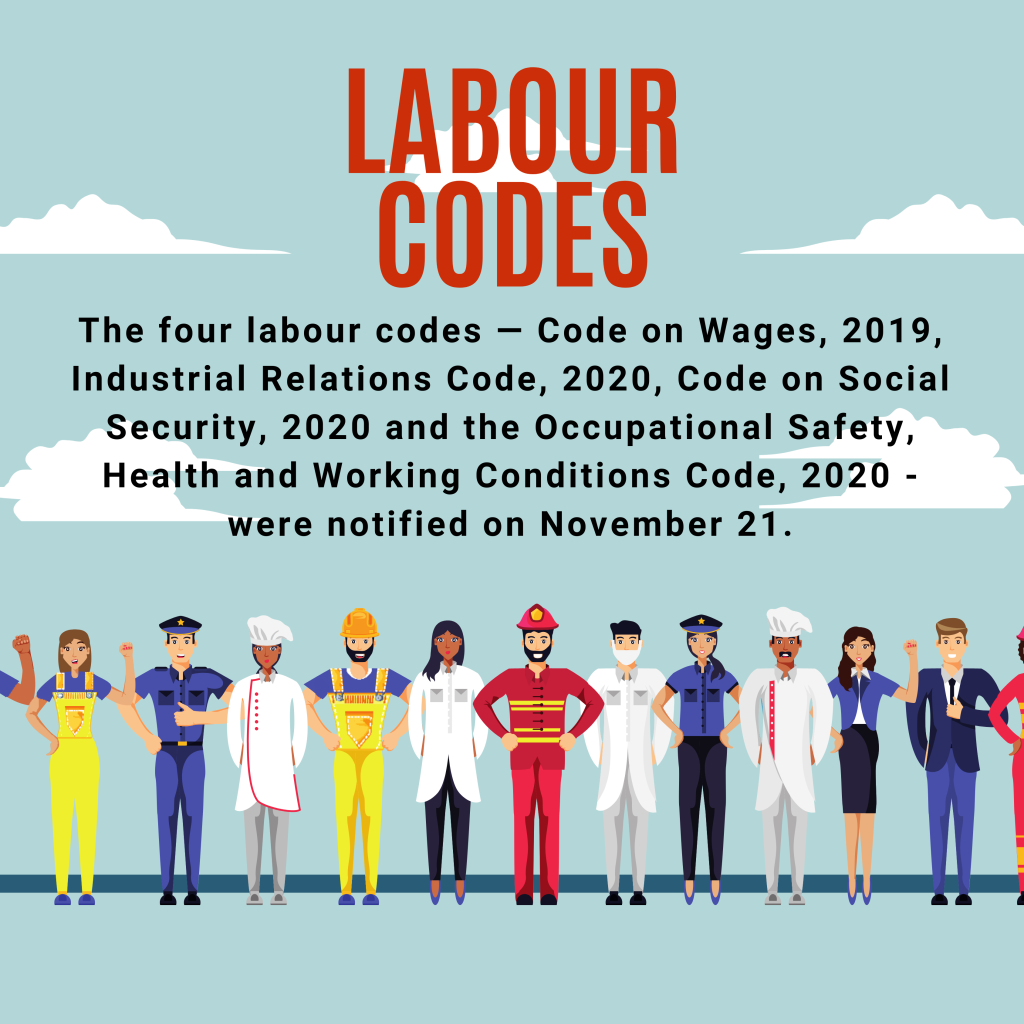
On November 21, 2025, India implemented four new Labour Codes that consolidate and replace 29 outdated central labour laws, marking one of the most significant labour reforms since Independence. These codes represent a historic modernization of India’s labour governance framework, introducing universal worker protections, simplified compliance procedures, and expanded social security coverage. For business advisors, human resource professionals, and employers, understanding these transformative changes is critical for ensuring organizational compliance and maintaining harmonious industrial relations.
Overview of the Four Labour Codes
The four Labour Codes are:
The Code on Wages, 2019 – Establishes universal minimum wage protections and defines wage structures across all employment sectors.
The Industrial Relations Code, 2020 – Regulates strikes, lockouts, industrial disputes, and establishes mechanisms for dispute resolution and worker protections.
The Code on Social Security, 2020 – Extends social security benefits, including provident fund, pension, and insurance schemes, to all workers including gig, platform, and unorganised workers.
The Occupational Safety, Health and Working Conditions Code, 2020 – Sets national safety standards, health requirements, and working conditions applicable across industries.
These codes apply nationwide and supersede existing central labour legislation, though state-specific rules are still being developed and will follow in the coming weeks.
The Code on Wages, 2019: Universal Protection and Fair Compensation
Key Revolutionary Changes
Universal Minimum Wages for All Workers
The most transformative change under the Code is the extension of minimum wage protection to all employees across all sectors, irrespective of their employment type. Previously, under the Minimum Wages Act, 1948, minimum wages applied only to “scheduled employments” listed in the act—covering approximately 30% of the workforce. This left millions of workers in unscheduled sectors without statutory wage protection.
Impact: The Code now ensures that every worker—whether employed in factories, offices, shops, services, or informal sectors—is guaranteed a statutory minimum wage. This eliminates wage undercutting and promotes equitable compensation across the country.
National Floor Wage System
The Code introduces a National Floor Wage (NFW) as a baseline, set by the Central Government based on minimum living standards including food, clothing, housing, and other essentials.
How it works:
The Central Government fixes a floor wage applicable across all states.
State governments must ensure their minimum wages are not lower than this floor level.
The floor wage is revised at regular intervals to reflect inflation and living cost changes.
This mechanism prevents states from competing to attract investments by suppressing worker wages—a critical safeguard for workers’ welfare and regional equity.
Minimum Wage Components
The Code permits minimum wages to consist of:
Basic wage – The foundational wage component.
Allowances – Dearness allowance, house rent allowance, and other statutorily prescribed allowances.
Piece-rate wages – For workers engaged in piecework, specified on hourly, daily, or monthly basis.
Employers must ensure that the total of all components meets or exceeds the statutory minimum wage.
Wage Payment and Deduction Provisions
Timely Payment of Wages
Employers must pay wages on or before the last day of the period for which wages are due. Delays attract penalties.
Restrictions on Deductions
The Code restricts deductions from wages to statutory obligations only, such as income tax, provident fund contributions, and legal penalties. Employers cannot deduct wages for:
- Tools or materials provided by the employer
- Damage to property not caused by the worker’s wilful act or gross negligence
- Fines for disciplinary breaches (except in specified cases)
- General penalties or deductions that reduce wages below the minimum wage
Working Hours and Overtime
Normal Working Hours
The Code maintains the long-standing standard of 8 hours per day and 48 hours per week.
Overtime Provisions
Work beyond the prescribed hours is permitted only with the worker’s consent.
Overtime compensation is mandated at double the ordinary rate of wages, with limits on maximum overtime—typically 4 hours per day and 48 hours per month.
Special provisions apply for women workers, who historically were restricted from night work. The new Code permits women to work night shifts across all sectors, including mines and hazardous industries, subject to safety measures, consent, and employer provision of safe transportation.
The Industrial Relations Code, 2020: Modern Dispute Resolution and Worker Protections
Modernized Strike and Lockout Provisions
Extended Notice Period for Strikes and Lockouts
A fundamental change is the extension of the notice period for strikes and lockouts from 6 weeks to 60 days before initiating industrial action.
Previous Regime (Industrial Disputes Act, 1947): 6 weeks’ notice; strike cannot commence within 14 days of notice.
Current Regime (Industrial Relations Code, 2020): 60 days’ notice; strike/lockout cannot commence within 14 days of notice.
Impact: This extended window provides a significantly longer period for conciliation, negotiation, and intervention by labour authorities, promoting industrial peace and minimizing abrupt shutdowns.
Prohibition During Dispute Proceedings
Strikes and lockouts are prohibited:
During the pendency of conciliation, arbitration, or tribunal proceedings.
For 60 days after the conclusion of such proceedings (previously 2 months under the Industrial Disputes Act, but now standardized to 60 days).
This ensures that legal mechanisms are allowed to function without interruption and prevents workers from resorting to strikes while formal dispute resolution is in progress.
Broadened Definition of Strike
The Code broadens the definition of “strike” to include concerted casual leave movements, preventing circumvention of legal restrictions through organized mass absence.
Components of a legally recognized strike:
Cessation of work by a body of persons employed in any industry.
Acting in combination or under common understanding.
Refusal to continue work or accept employment.
Includes: Concerted casual leave by 50% or more workers on a given day.
Expanded Coverage to All Establishments
Previously, the requirement for notice before strikes/lockouts applied primarily to public utility services (railways, airlines, etc.).
Now, the requirement extends to all industrial establishments, significantly restricting the right to strike across the economy.
Illegal Strikes and Lockouts
A strike or lockout is deemed illegal if:
It commenced in contravention of the notice requirements under Section 62 or 63.
It is continued despite prohibition orders issued by competent authorities.
Penalties for Illegal Strikes:
Participants in illegal strikes face fines up to ₹500 per day (or more, depending on state rules).
Penalties for Employers Instigating Illegal Lockouts:
Employers may face fines up to ₹1,000 per day plus imprisonment for up to one year.
Exceptions to Notice Requirements
Trade unions are not required to give notice of a strike if a strike by workers already exists; instead, the employer must intimate the Government Authority on the day of declaration of the strike.
This provision recognizes spontaneous worker responses to immediate employer actions.
Strengthened Reporting Obligations
Employers must report notices of strikes or lockouts to both the appropriate Government and the Conciliation Officer within 5 days, enhancing transparency and enabling early intervention.
Layday and Retrenchment: Increased Thresholds
Pre-Code (Industrial Disputes Act):
Establishments with 100 or fewer workmen could implement layoffs and retrenchment without government approval.
Post-Code (Industrial Relations Code):
Establishments with less than 300 workmen can now undertake layoffs, retrenchment, and closures without government approval.
Impact: This significantly eases compliance for smaller employers while expanding protections for larger establishments’ workers.
Fixed-Term Employment Benefits
A major advancement for workers:
Fixed-term employees now receive gratuity after one year of service, a reduction from the previous five-year requirement for permanent employees.
Fixed-term employees are entitled to benefits on par with permanent workers, eliminating historical discrimination between employment categories.
The Code on Social Security, 2020: Universal Coverage and Worker Welfare
Extended Social Security for All Workers
A landmark shift in coverage:
Employees’ State Insurance (ESI) benefits are now available pan-India and apply to establishments with even a single employee engaged in hazardous work, compared to the previous threshold of 20 or more workers.
Previously, social security schemes covered approximately 10-12% of the workforce; the new Code extends coverage to all workers in organized and unorganized sectors.
Gig and Platform Workers Recognition
For the first time in Indian labour law, gig and platform workers are formally defined and protected:
Aggregators (platforms like ride-sharing and delivery apps) are required to contribute a share of revenue to a social security fund for worker benefits.
Gig and platform workers gain access to:
- Provident fund schemes
- Pension benefits
- Deposit-linked insurance
- Health coverage and portability of entitlements
Impact: This formalization brings millions of informal workers into the social security net, addressing a long-standing gap in labour protection.
Universal Entitlements Across Sectors
The Code ensures:
Uniform provident fund (PF) schemes applicable across sectors.
Portable entitlements for migrant workers, who can carry benefits across states without reregistration.
Equal wages and prohibition of gender-based discrimination, including protections for transgender workers.
Health benefits, including free annual health check-ups for workers above 40 years of age.
The Occupational Safety, Health and Working Conditions Code, 2020
National Safety Standards
The Code prescribes comprehensive national safety standards applicable across industries, replacing fragmented state-level regulations with uniform protections.
Health and Medical Benefits
Free Annual Health Check-ups: Workers above 40 years of age are entitled to free annual medical examinations, ensuring early detection of occupational health issues.
Workplace Safety: Employers must provide:
- Personal protective equipment (PPE)
- Safe working conditions
- Regular safety audits and risk assessments
- Training on safety protocols
Rest Intervals and Fatigue Management
Workers are entitled to rest intervals of at least 30 minutes after 5 hours of continuous work, preventing fatigue-related accidents and health deterioration.
Women Workers’ Protections
Expanded night-work opportunities: Women can work night shifts across sectors, including mines and hazardous industries, subject to:
- Employer-provided safe transportation
- Written consent from the worker
- Appropriate safety measures
- Exclusion of particularly hazardous tasks
This represents a significant shift from historical restrictions that limited women’s employment opportunities.
Simplified Compliance Framework
Single Registration, License, and Return System
A cornerstone of the labour code reforms is the dramatic simplification of compliance procedures:
Previously, establishments registered separately under multiple laws (Factories Act, Shops and Establishments Act, etc.), maintaining multiple licenses and filing different returns.
Now, all registration, licensing, and compliance reporting operates under a single unified system.
Benefits:
Reduced administrative burden, particularly for small and medium enterprises (SMEs).
Unified inspection and compliance processes.
Single point of contact for all labour-related matters.
Enhanced Factory Thresholds
Factory applicability thresholds have been increased:
With power: From 10 to 20 workers.
Without power: From 20 to 40 workers.
This relieves compliance burden for small manufacturing units while maintaining protections for workers in larger facilities.
Contract Labour Reforms
Threshold increase: Contract labour applicability has been raised from 20 to 50 contract workers, reducing compliance obligations for employers using contract workers on a limited scale.
All-India License: Contractors now receive a nationwide license valid for 5 years, replacing the previous work-order-based licensing system.
Auto-Generation of Licenses: Licenses are now auto-generated for eligible contractors, streamlining the licensing process.
Accountability of Principal Employers: If contractors fail to pay contract workers’ wages, principal employers are liable to pay unpaid wages, ensuring protection of workers against contractor defaults.
Transition and Implementation Timeline
Current Status (As of December 2025)
All four Labour Codes came into effect on November 21, 2025.
Central and state-specific rules are still being finalized and are expected to be notified within the coming weeks.
Interim Provisions
During the transition period:
Existing rules and notifications issued under previous labour laws remain in force until new rules are formally notified.
Employers should treat this as a grace period to audit their policies, compensation structures, and compliance procedures against the new Codes.
Consultations with stakeholders (employers, worker unions, and professional bodies) are ongoing to finalize operational guidelines.
Comparative Summary: Key Changes Under New Labour Codes
| Aspect | Previous Laws | New Labour Codes (2025) | Impact |
| Minimum Wage Coverage | Only scheduled employments (~30% of workforce) | All workers across all sectors | Universal protection; wider coverage |
| Minimum Wage Revision | Indefinite intervals | Every 5 years | Ensures wages keep pace with inflation |
| National Floor Wage | Non-existent | Statutory floor established | Prevents wage suppression by states |
| Notice for Strike/Lockout | 6 weeks | 60 days | Extended negotiation window |
| Social Security Coverage | Limited (organized sector ~10-12%) | Universal (all workers, gig, platform) | Formalization of informal sector |
| Gratuity for Fixed-Term Workers | 5 years eligibility | 1 year eligibility | Improved benefits for temporary workers |
| Women Night Work | Restricted | Permitted across sectors (with safeguards) | Expanded employment opportunities |
| Factory Threshold (with power) | 10 workers | 20 workers | Reduced compliance burden for small units |
| ESI Applicability | 20+ workers threshold | Single employee in hazardous work | Expanded health insurance access |
| Registrations and Licenses | Multiple separate registrations | Single unified system | Streamlined compliance |
Compliance Imperatives for Organizations
Immediate Actions for Employers
Given that the Codes are now in effect, organizations should urgently:
- Conduct Wage Audits: Verify that all employee compensation meets the new statutory minimum wage requirements. Review wage components (basic wage, allowances) and ensure compliance.
- Update Appointment Letters: Issue mandatory appointment letters detailing employment terms, working hours, wages, and benefits to all employees as per Code requirements.
- Review Policies: Update HR policies on:
- Working hours and overtime
- Wage deductions and payment terms
- Health and safety procedures
- Dispute resolution mechanisms
- Employment Agreements: For contract and fixed-term workers, revise agreements to reflect new entitlement provisions (gratuity after 1 year, equal benefits with permanent workers).
- Social Security Registration: Ensure all eligible employees are registered for provident fund, ESI, and other social security schemes.
- Safety and Health Measures: Establish protocols for workplace safety, health check-ups for workers above 40, and safe working conditions compliance.
- Monitor State Rules: Track notifications of state-specific labour rules expected in the coming weeks, as these will provide detailed implementation guidelines.
Sector-Specific Considerations
Manufacturing and Factories:
Verify factory registration under the new threshold criteria (20 workers with power, 40 without).
Review working hours, overtime policies, and rest interval provisions.
Ensure contract labour compliance with revised thresholds and principal employer obligations.
Services and Retail:
Establish uniform working hours across locations.
Implement appointment letter issuance for all staff.
Develop policies on night-shift work for women (if applicable) with safety measures.
Gig and Platform Businesses:
Establish contribution mechanisms to worker social security funds.
Implement classification protocols to identify gig workers and ensure benefit access.
Challenges and Considerations
Concerns Raised by Stakeholders
While the Labour Codes aim to modernize India’s labour framework, critics and stakeholders have raised concerns:
Restrictions on Worker Rights: The 60-day notice requirement and extended post-proceeding restrictions may limit workers’ ability to rapidly respond to unfair employer practices.
Strike Restrictions: The expansion of notice requirements from public utilities to all establishments may significantly curtail workers’ strike rights, particularly in informal sectors.
Exemptions for Small Businesses: Increased thresholds for factory and contract labour applicability may exempt thousands of small units from compliance, potentially leaving workers in these units with fewer protections.
Implementation Gap: The absence of state-specific rules during this transition period creates uncertainty for employers regarding exact compliance requirements.
Progressive Aspects
Counterbalancing these concerns, the Codes offer significant advances:
Universal coverage extends protections to historically excluded workers (gig, platform, unorganised).
Fixed-term worker protections eliminate historical discrimination in benefit eligibility.
Women’s night-work permissions expand economic opportunities if safety measures are adequately enforced.
Simplified compliance reduces bureaucratic burden, particularly for SMEs.
Conclusion
The implementation of the four new Labour Codes on November 21, 2025, represents a landmark modernization of India’s labour governance framework. By consolidating 29 outdated laws into four coherent codes, the government aims to balance worker protection with business flexibility, formalize the informal economy, and align Indian labour standards with global norms.
For corporate compliance professionals, business advisors, and HR practitioners, the new Codes present both opportunities and challenges. While simplified registration and compliance mechanisms reduce administrative burden, the extension of universal protections to all workers and the formalization of gig work require significant organizational restructuring.


