-
 Puregen Labs Meclizine
1 × $$55.00



Build a Business That Does Not Depend Only on You
October 03, 2026
23 views
Skills help you start a business. Systems help you run it consistently. Learn how simple processes, checklists, and clear responsibilities can support your new business.
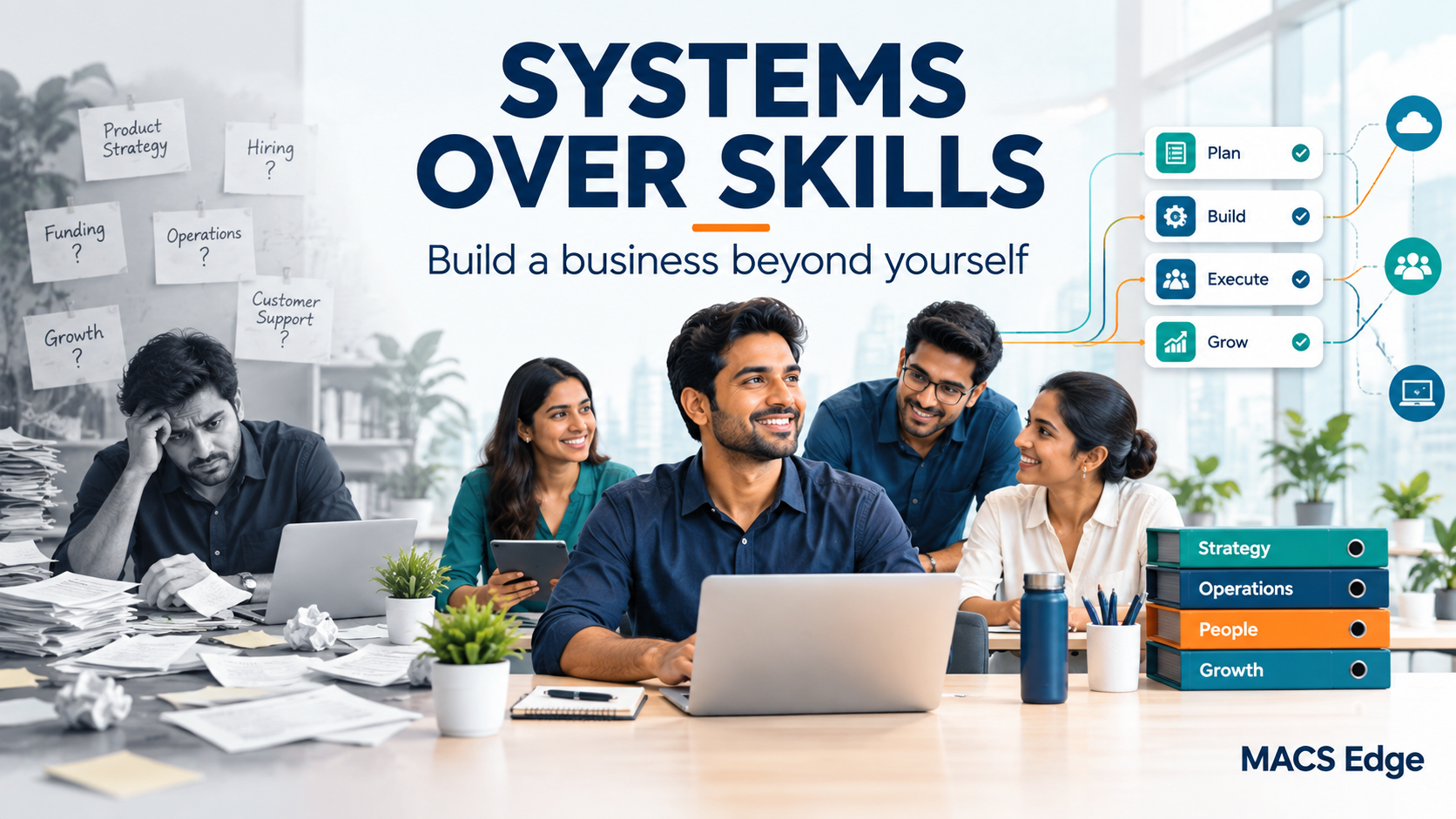
A skilled founder can start a business. But a business becomes difficult to manage when every quotation, customer query, delivery decision, and payment reminder requires the founder’s personal attention.
For a new business, “systems over skills” does not mean that talent is unimportant. It means building a clear way of working so that your skills can produce consistent results through a team—not only through your own effort.
Instead of asking, “How can I do everything better?” ask, “How can we make sure important work gets done properly, even when I am not handling every step?”
What Is a Business System?
A business system is an agreed method for completing a recurring activity. For this article, think of it as a combination of instructions, responsibilities, records, deadlines, and review points.
It does not have to be expensive software. Your first system could be a shared spreadsheet, a customer-onboarding checklist, a quotation template, or a weekly review of outstanding invoices.
| Business Activity | Depending Only on Skill | Supporting Skill with a System |
|---|---|---|
| Sales | The founder remembers whom to contact. | A lead tracker records the next action and follow-up date. |
| Customer onboarding | An experienced employee knows what to collect. | A checklist identifies required information and documents. |
| Work delivery | Each employee follows a personal method. | The team follows agreed steps, with room for professional judgement. |
| Billing | Invoices are raised when someone remembers. | A defined completion milestone triggers invoicing. |
| Quality review | The owner checks everything informally. | A named reviewer checks work against defined criteria. |
Real-World Example: McDonald’s
McDonald’s offers a well-documented example of turning a business activity into a repeatable operating model. Richard and Maurice McDonald opened their restaurant in San Bernardino, California, in 1940. In 1948, they redesigned its operations and introduced the “Speedee Service System.”
The brothers simplified the menu, organised food preparation around an assembly-line approach, and replaced carhop service with a walk-up, self-service model. Their focus was fast, consistent, affordable food—not simply having someone who could make a good hamburger.
McDonald’s own history records that the restaurant closed for three months for alterations and reopened in December 1948 with a nine-item menu. Its signature hamburger cost 15 cents.
The important lesson is the redesign of the work itself. Rather than treating every order as an entirely separate exercise, the brothers developed a clearer, more repeatable method of preparing and serving a limited range of products. The success of the concept subsequently led them to begin franchising.
| Documented Change | What a New Business Can Learn |
|---|---|
| A limited, standardised menu. | Start with a manageable range of products or services instead of promising everything. |
| An assembly-line approach to preparation. | Break recurring work into clear stages rather than leaving the entire process undefined. |
| A walk-up, self-service model. | Question whether every existing step is necessary for the customer experience you want to deliver. |
| A concept that the brothers began franchising. | Consider how another team would reproduce your service before expanding to another location. |
The takeaway is not that every business should operate like a fast-food restaurant. It is that a good product and a well-designed delivery process are different things—and a growing business needs both.
A system also does not guarantee success by itself. Your product, customer demand, pricing, people, and financial decisions still matter.
Applying the Lesson to a New Business
Consider a newly established service business offering design, consulting, accounting support, or maintenance services. The following is an illustrative scenario, not a reported client case.
At first, the founder handles every enquiry personally. Customer details remain in WhatsApp chats, quotations are prepared from scratch, and deadlines are remembered rather than recorded.
As work increases, the founder becomes the link between every activity. Employees wait for instructions, customers ask repeatedly for updates, and completed work sometimes waits for an invoice.
The business does not necessarily need more talented people before it can improve. It first needs a clear route from enquiry to delivery and payment.
| Stage | Proposed Process | Completion Evidence |
|---|---|---|
| Enquiry received | Record the customer, requirement, source, and responsible person. | An entry in the enquiry tracker. |
| Requirement clarified | Confirm scope, expected outcome, and timeline. | A written requirement summary. |
| Quotation issued | Use a template with scope, exclusions, price, and payment terms. | A saved quotation and dispatch record. |
| Order accepted | Record acceptance and any agreed advance-payment requirement. | Customer confirmation and payment record, where applicable. |
| Work assigned | Create tasks with a responsible person and deadline. | A task entry linked to the customer assignment. |
| Work reviewed | Check the output against the agreed scope. | Reviewer approval or correction notes. |
| Delivery and billing | Send the deliverable and raise the invoice at the agreed milestone. | Delivery confirmation and invoice. |
| Payment follow-up | Review unpaid invoices and record the next action. | An updated collections tracker. |
This proposed workflow makes responsibility visible. It also gives the founder specific points to review instead of requiring continuous involvement in every routine step.
Build Five Starter Systems
For a new business, the following five systems provide a practical starting framework. Adapt them to your actual operations rather than adopting them as rigid rules.
| System | What It Should Cover | Simple Starting Tool |
|---|---|---|
| Sales and follow-up | Enquiries, quotations, next actions, and customer decisions. | A shared spreadsheet or basic CRM. |
| Customer onboarding | Scope confirmation, document collection, payment terms, and contact details. | A checklist and welcome-message template. |
| Delivery and quality | Task stages, ownership, deadlines, review criteria, and customer handover. | A task board and delivery checklist. |
| Accounts and collections | Invoices, receipts, expenses, outstanding balances, and follow-up actions. | Accounting software and a receivables report. |
| Records and compliance | Applicable obligations, supporting documents, responsibilities, and completion records. | A compliance calendar and organised folders. |
Create a System Before Automating
Before choosing software, write down what should happen. Use these questions to design your first process:
- What event starts the work?
- Who is responsible for moving it forward?
- What information is required?
- What steps must happen, and in what order?
- What does successful completion look like?
- Who checks the result?
- What happens when information is missing or a customer requests a change?
For example, an automated invoice reminder needs accurate invoice data, payment status, customer details, and rules for disputed invoices. Define those requirements before switching on reminders.
Use automation for suitable routine steps. Keep human approval where the task involves exceptions, sensitive communication, or professional judgement.
A Practical First-Month Plan
Use this suggested four-week plan to introduce systems without turning your new business into a documentation project.
| Period | Action | Target Output |
|---|---|---|
| Week 1 | List recurring tasks and choose one that causes frequent confusion or delay. | One priority process with a named owner. |
| Week 2 | Write the steps and prepare the required template or tracker. | A short working checklist. |
| Week 3 | Ask another person to use it on actual work and record unclear steps. | A tested and revised process. |
| Week 4 | Review completion, missed steps, and exceptions before selecting the next process. | A usable first system and a clear next priority. |
For your internal review, track practical indicators such as overdue tasks, enquiries awaiting follow-up, work returned for correction, and completed assignments awaiting invoicing. Compare your own results over time rather than relying on an arbitrary performance target.
Keep Expertise Where It Matters
Not every decision belongs in a checklist. Negotiation, technical advice, unusual customer requests, and complex problem-solving may require experienced judgement.
Separate routine work from exceptions. Define what employees can handle independently and what they should escalate, including who makes the final decision.
Your goal is not to remove skilled people from the business. It is to give skilled people a dependable structure in which to work.
Build a business where routine tasks do not need constant reminders, customers receive a clear experience, and the founder can focus on decisions that genuinely require their attention.
Build a Structured Business from Day One
Planning to start a private limited company? Make registration the starting point of an organised business—not the final step. Pair your incorporation plans with clear responsibilities, accounting processes, document management, and a compliance calendar.
Apply the “systems over skills” approach from the beginning: define how your business will handle customer enquiries, approve expenses, deliver work, and maintain records.
Start your private limited company registration journey with a clear plan for how the business will operate, not just how it will be incorporated.
Register Your Company. Build Your Systems. Grow with Confidence.
Ready to Simplify Your Compliance Journey?
Book a consultation with our experts and get a customized compliance roadmap for your business.