-
 Puregen Labs Meclizine
1 × $$55.00
Puregen Labs Meclizine
1 × $$55.00



Decoding the Social Code: What Service and Trading Enterprises Must Know
June 12, 2026
49 views
The Code on Social Security, 2020 reshapes social security obligations for service and trading businesses, covering PF, ESI, gratuity and new protections for gig and unorganised workers.
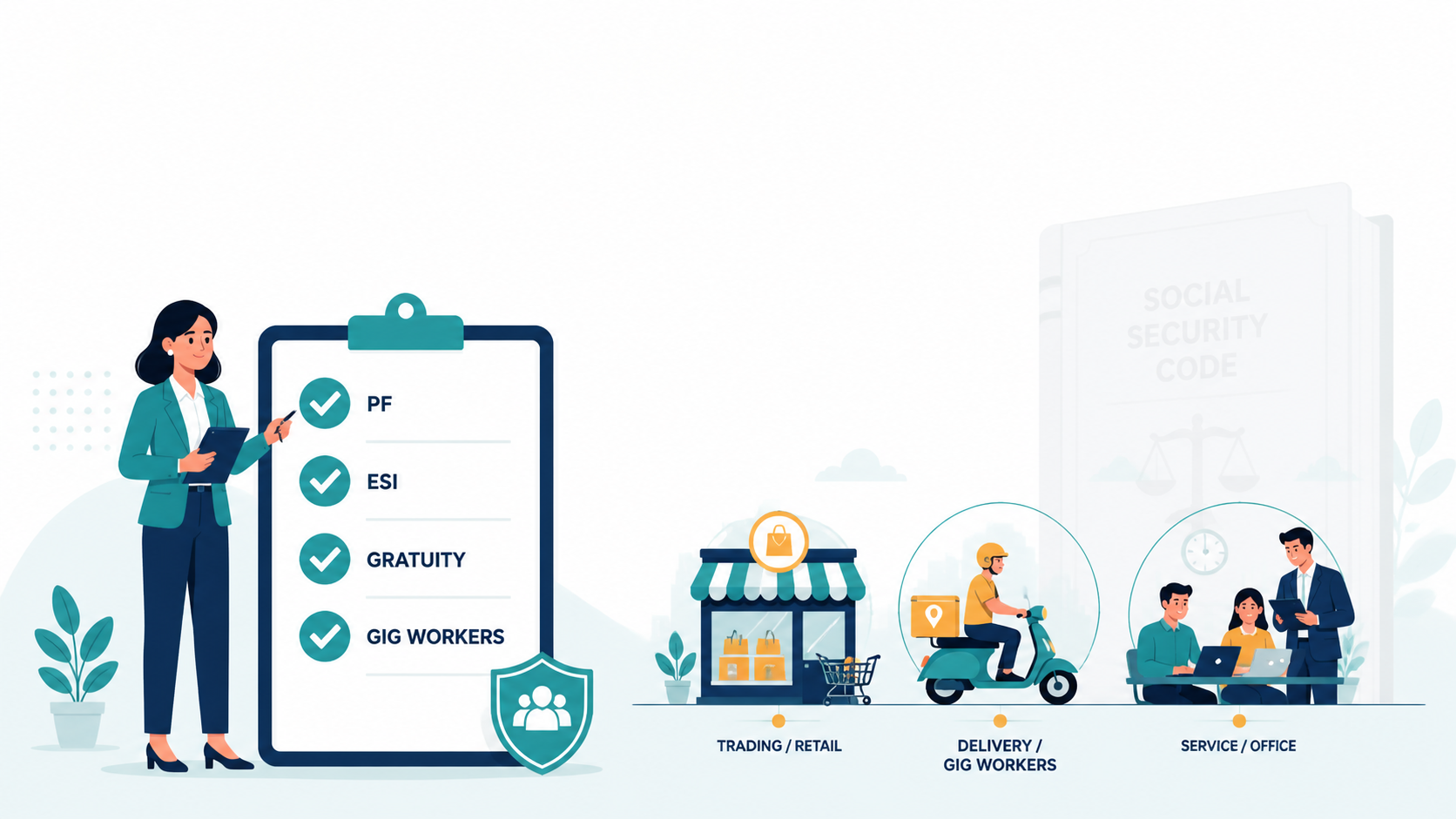
India’s new labour codes mark a significant shift from a fragmented, sector-wise approach to a consolidated and uniform framework for labour regulation. For service and trading businesses, which often operate with a mix of permanent staff, contract workers, and outsourced manpower, understanding the social security dimension under the new regime is critical for both compliance and workforce stability.
Understanding the Social Code in the Context of Service and Trading Sectors
The “social” element of the new labour framework is primarily embodied in the Code on Social Security, 2020, which consolidates multiple social security legislations into one unified law. For service entities (such as IT/ITES, consulting, professional services, hospitality, healthcare, etc.) and trading businesses (wholesale, retail, distribution, e‑commerce), this Code defines how social protection is to be extended to employees and workers engaged through various modes of engagement.
Many service and trading establishments function with lean core teams and rely heavily on contract labour, vendor manpower, and outsourced services. The Social Security Code requires such businesses to reassess who is covered as an “employee” or “worker” and ensure that the appropriate social security obligations are discharged, either directly or through contractor arrangements.
Core Objective of the Social Code for Businesses
The principal objective of the Social Security Code is to create an integrated and inclusive framework of welfare benefits, rather than treating social security as an isolated compliance requirement. For service and trading establishments, this means moving from a purely cost-focused approach to HR to a more structured, benefits‑linked employment model.
The Code aims to ensure that employees and workers engaged in offices, branches, outlets, warehouses, godowns, and even field operations are able to access core welfare benefits like provident fund, health insurance through ESI (where applicable), gratuity, and other notified schemes. This becomes particularly important where manpower is spread across multiple locations or engaged through agencies.
Social Security Benefits Relevant to Service and Trading Enterprises
The Code on Social Security consolidates and realigns various social security benefits that are commonly encountered in service and trading businesses. Key benefits include:
Provident Fund (PF) – Applicable where establishments meet the threshold, PF contributions ensure retirement savings and long‑term financial security for employees. For service and trading firms with high employee turnover, proper PF compliance helps build employer credibility and reduce disputes at exit.
Employees’ State Insurance (ESI) – For eligible establishments, ESI provides medical and sickness benefits to employees and their families. This is especially relevant for trading units with shop floor workers, warehouse staff, and service businesses with lower and mid‑level employees drawing wages within notified limits.
Gratuity and Maternity Benefits – Service companies often engage employees in long‑term roles, where gratuity obligations and maternity benefits become a key part of the HR cost structure. Under the Social Security Code, fixed‑term employees may also be eligible for gratuity on a pro‑rated basis, which affects contractual staffing practices in both service and trading contexts.
Unorganised and Platform Workers’ Schemes – For trading enterprises and service platforms that rely on delivery personnel, field agents, or app‑based workers, there is a greater emphasis on designing or contributing to schemes that extend basic social protection even to non‑traditional worker categories.
Inclusion of Gig and Platform Workers in Service and Trading Models
Many modern trading and service businesses, particularly in e‑commerce, logistics, last‑mile delivery, ride‑hailing, and app‑based services, are built around gig and platform workers. The Social Security Code recognises these categories and enables the government to frame specific schemes for them.
For businesses, this means that engagement models which previously treated such workers purely as independent contractors may now attract defined obligations under notified schemes. Service aggregators and trading platforms must therefore evaluate their operating agreements, aggregator responsibilities, and cost models to accommodate potential contributions towards the social security of gig and platform workers.
Uniform Wage Definition and Its Impact on Costing and Pricing
A key reform under the new labour code framework is the move towards a more uniform definition of “wages”. For service and trading businesses, this impacts how salary structures are designed, especially where multiple allowances and reimbursements are used to optimise cash flows.
Since social security contributions like PF and gratuity are typically linked to wages, a uniform definition prevents excessive fragmentation of pay into allowances. Service companies (for example, BPOs, consulting firms, professional practices) and trading companies (retail chains, distributors) will need to realign pay structures to ensure that statutory contributions are computed correctly, which may slightly increase the effective cost per employee but brings transparency and reduces future litigation risk.
Compliance Responsibilities of Service and Trading Employers
In practice, service and trading establishments often deal with large numbers of employees and contract workers across branches, outlets, and client locations. Under the Social Security Code, employers are expected to ensure registration, timely contribution deposits, maintenance of records, and furnishing of returns in respect of all covered employees.
Where manpower is obtained through contractors or service providers (for example, housekeeping, security, logistics, sales promotion staff), principal employers must review contract terms to clearly allocate responsibilities for social security contributions. Failure to do so can result in financial exposure, penalties, and reputational risk for the principal business.
Practical Impact on Employees in Service and Trading Organisations
For employees, the social code framework is expected to provide better continuity and predictability of benefits, even when they move between different employers within the service and trading ecosystem. Proper PF, ESI, and gratuity coverage helps workers in these sectors handle employment transitions with a basic level of financial and medical security.
In addition, formalisation of employment through appointment letters and documented HR policies, which is encouraged under the new codes, gives workers in retail trade, logistics, hospitality, and other service lines a clearer understanding of their rights, entitlements, and exit benefits.
Strategic Importance of Social Security Compliance for Service and Trading Businesses
Beyond avoiding penalties, robust social security compliance can become a differentiator for service and trading companies in terms of employer branding and talent retention. Businesses that honour their statutory obligations and communicate benefits transparently are more likely to attract and retain skilled employees in a competitive market.
For promoters and management, the Social Security Code should be viewed not merely as a compliance burden, but as an opportunity to strengthen organisational culture, reduce disputes, and create a more stable and motivated workforce across service and trading operations.
Conclusion – Aligning Service and Trading Enterprises with the Social Code
The social code under the new labour law framework brings service and trading businesses under a more structured and inclusive social security net. By revisiting wage structures, revising HR documentation, and reviewing contractor arrangements, organisations can align themselves with the new requirements while also enhancing employee welfare.
For practitioners, especially company secretaries and compliance professionals, this is an ideal time to guide clients in the service and trading space on how to practically implement the Social Security Code – not just to “tick the box”, but to build sustainable, worker‑friendly business models.