-
 Puregen Labs Meclizine
1 × $$55.00
Puregen Labs Meclizine
1 × $$55.00


Documents Required to Register a Company in India
May 08, 2026
101 views
Planning to register a company in India? This blog walks you through the key documents required, explains the purpose of each, and shares practical, tips to avoid delays and resubmissions.
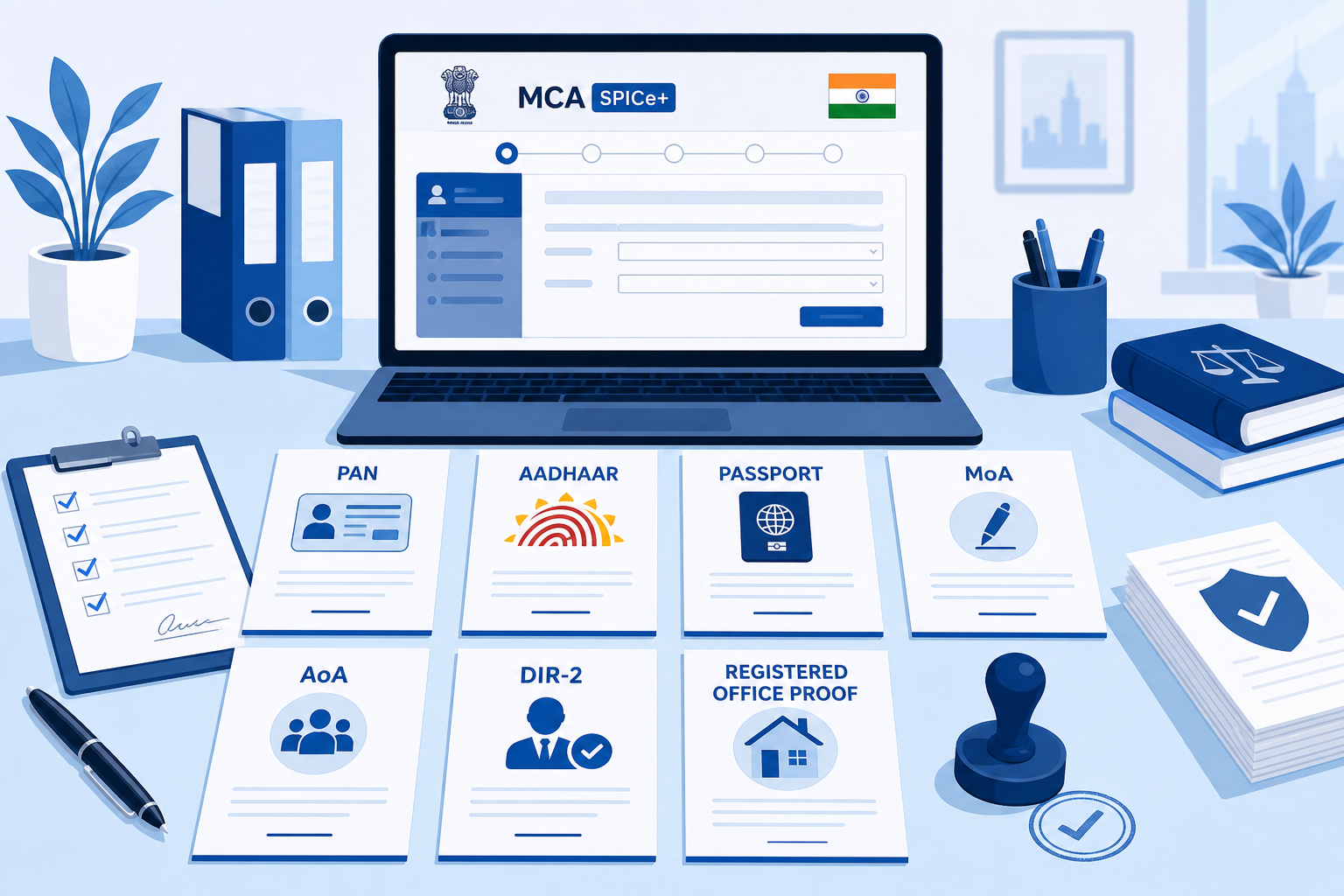
Starting a company is exciting, but the documentation part often feels heavier than it should. Most delays in company registration do not happen because the business idea is weak — they happen because a document is missing, outdated, mismatched, or not properly signed.
This is why it helps to understand not only what documents are needed, but also why each document is asked for. When you know the purpose behind each paper, the entire company registration process becomes much easier to organise and much less stressful.
Simple idea: MCA asks for documents mainly to verify three things — who you are, where the company will operate from, and whether the directors and subscribers have legally agreed to form the company.
Why these documents are required
When a company is incorporated through the SPICe+ route, the Ministry of Corporate Affairs checks the identity of promoters, the authenticity of the proposed registered office, and the legal validity of the incorporation documents. This is why identity proof, address proof, office proof, declarations, and constitutional documents are all submitted together.
🪪
Identity verification
PAN, Aadhaar, passport, and similar records help prove that the proposed directors and subscribers are genuine individuals.
🏢
Office verification
Registered office documents show that the company has a real, usable address for legal notices and official communication.
✍️
Legal consent
Forms like DIR-2 and INC-9 confirm that directors and subscribers are willing and legally eligible to be part of the company.
Core document checklist
For most private limited company registrations, the document set can be grouped into four practical buckets: promoter KYC, registered office proof, incorporation documents, and statutory declarations. This classification helps promoters avoid confusion and collect papers in the right sequence.
| Purpose | Why it is used | Document |
|---|---|---|
| Identity proof | To verify the identity of directors and subscribers | PAN, Aadhaar, Passport, Driving Licence |
| Address proof | To confirm present residential address of the promoter | Bank statement, electricity bill, telephone bill |
| Registered office proof | To establish the company’s official address | Rent agreement, NOC, utility bill |
| MoA / AoA | To define the company’s objects and internal rules | e-MoA and e-AoA under SPICe+ |
| DIR-2 / INC-9 | To record legal consent and declaration by directors/subscribers | Director consent and subscriber declaration |
Documents of directors and subscribers
PAN Card
PAN is one of the most important identity documents for Indian promoters. It helps the authorities link the promoter’s identity with tax records and is commonly used as the primary KYC document during incorporation.
Aadhaar Card
Aadhaar is generally used as an additional identity and address proof for Indian residents. It also helps match the promoter’s personal details with the details entered in the MCA application.
Passport
For NRIs and foreign nationals, passport is the main identity document and is usually mandatory. For Indian residents, it is optional in many cases but can still help where additional identification support is needed.
Residential Address Proof
This document is used to verify the current place of residence of the proposed director or subscriber. It is usually a recent utility bill or bank statement and should generally not be older than two months.
Photograph, Mobile Number, and Email ID
These are used for identification, communication, and procedural filing purposes. The process is digital, so email and mobile details are not merely formality — they are part of the actual compliance workflow.
📌
Best practical tip
Check whether the name, father’s name, and date of birth match across PAN, Aadhaar, and passport before filing. Even a small mismatch can trigger resubmission.
📅
Watch the date
Address proof is often rejected simply because it is too old. Use the latest available bill or bank statement.
🖊️
Sign properly
Where self-attestation is needed, make sure copies are signed clearly and consistently.
Registered office documents
The registered office is the legal address of the company. It is the place where notices from government departments, tax authorities, courts, and regulators may be sent, which is why the MCA asks for separate proof of office use.
| Office document | Purpose | Common note |
|---|---|---|
| Rent agreement / ownership proof | To show legal right to use the premises | Used if office is rented or owned |
| NOC from owner | To confirm that the owner permits the address to be used as registered office | Very important where premises are not owned by the company |
| Utility bill | To verify the address is active and genuine | Usually should not be older than 2 months |
Tip: Many promoters collect the office electricity bill but forget the owner’s NOC. That single missing page often causes unnecessary delay.
MoA and AoA: why they matter
The Memorandum of Association (MoA) is used to define the company’s main objects — in simple words, what the company is being formed to do. The Articles of Association (AoA) are used to set out the company’s internal rules, management framework, and operating structure.
These are not just formal documents uploaded for compliance. They are foundational documents that shape the legal identity and governance framework of the company from day one.
📘
MoA
Tells the outside world what the company is formed to do.
📗
AoA
Explains how the company will function internally.
💡
Draft carefully
Poorly drafted objects or clauses can create practical issues later in banking, licensing, and operations.
DIR-2, INC-9, and other declarations
These forms are required because the MCA does not rely only on identity documents. It also requires direct legal confirmation from the people who are becoming part of the company.
DIR-2
This is the consent to act as director. It proves that the proposed director has agreed to take up the role and is not being added without knowledge or approval.
INC-9
This is the declaration by subscribers and first directors confirming legal eligibility and non-disqualification. It supports the integrity of the incorporation process.
Professional declaration
In many incorporation cases, a practicing professional also certifies that the filing requirements have been complied with. This adds another layer of procedural assurance.
Special document rules for NRIs and foreign nationals
When promoters are based outside India, the document list is broadly similar, but the execution requirements become stricter. This is because overseas documents often need notarisation, apostille, or consular attestation depending on the country of residence.
| Applicant type | Main identity document | Special requirement |
|---|---|---|
| Indian resident | PAN + Aadhaar / other ID | Self-attested documents usually sufficient |
| NRI | Passport | Overseas address proof and authentication may be needed |
| Foreign national | Passport | Passport and address proof generally need notarisation/apostille; translations required if not in English |
🌍
Apostille matters
For many overseas promoters, the issue is not the document itself but the missing apostille or attestation.
🈯
Translation first
If the original document is not in English, certified translation may be needed before filing.
📂
Keep scanned copies ready
Good quality scans save time during MCA upload and reduce avoidable technical rejections.
Common mistakes that delay company registration
- Mismatch in spelling of name across PAN, Aadhaar, passport, and address proof.
- Using utility bills or bank statements older than the acceptable period.
- Forgetting NOC from the property owner for the registered office.
- Uploading foreign documents without proper apostille, notarisation, or translation.
- Treating MoA and AoA as routine paperwork instead of carefully drafted legal documents.
Most mistake of all: collecting documents one by one only after the filing process begins. A simple checklist prepared in advance makes the whole process smoother.
Final word
Company registration is not difficult when the documentation is properly organised. The real key is to collect the right papers, understand why each one is needed, and ensure that names, addresses, dates, signatures, and supporting proofs are all aligned before filing.
If the documentation is handled carefully at the beginning, the incorporation process becomes faster, cleaner, and far less stressful for promoters, especially where there are multiple directors, NRIs, or foreign nationals involved.
Ready to Simplify Your Compliance Journey?
Book a consultation with our experts and get a customized compliance roadmap for your business.