-
 Puregen Labs Meclizine
1 × $$55.00
Puregen Labs Meclizine
1 × $$55.00


MSME ODR – Online Dispute Resolution for Delayed Payments
June 28, 2026
204 views
Struggling with delayed payments? Learn how the MSME ODR Portal helps Micro & Small Enterprises recover dues digitally — fast, paperless, and legally binding.
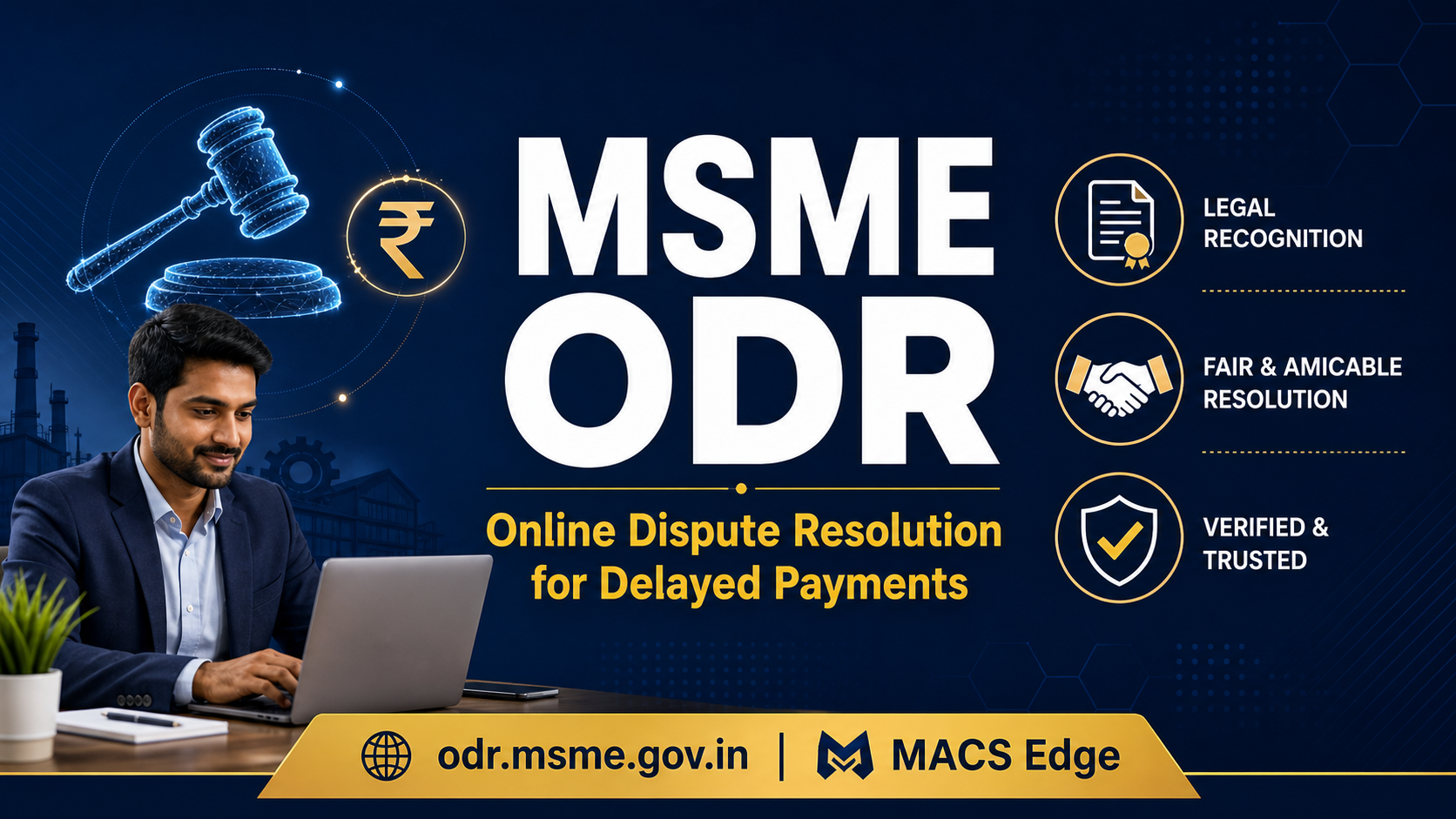
Are you a Micro or Small Enterprise struggling to recover pending payments from buyers? The Government of India has launched the MSME ODR Portal (odr.msme.gov.in) — a fully digital, time-bound, and legally binding dispute resolution system. Here's everything you need to know.
What is MSME ODR?
MSME ODR stands for Online Dispute Resolution — a government-backed digital platform developed by the Ministry of Micro, Small and Medium Enterprises (MSME) to help Micro and Small Enterprises recover delayed payments from buyers in a fast, cost-effective, and paperless manner. The portal was officially launched on June 27, 2025, on the occasion of MSME Day, and is accessible at odr.msme.gov.in.
The MSME ODR portal provides an end-to-end digital journey — from filing the complaint to receiving a legally enforceable award — without the need to visit any court or government office. It replaces the earlier MSME Samadhaan portal for all new delayed payment applications. Effective from October 15, 2025, all new cases must be filed exclusively through the MSME ODR Portal.
Why Was MSME ODR Launched?
Delayed payments have long been one of the biggest challenges for small businesses in India. Before the ODR portal, MSEs had to rely on the traditional MSEFC process — which was paper-heavy, slow, and required physical appearances. The Micro and Small Enterprises Facilitation Councils (MSEFCs) were burdened with a backlog of over 42,000 cases and more than ₹22,363 crore in pending dues on the Samadhaan platform.
The MSME ODR portal was designed to address these systemic bottlenecks. By combining Artificial Intelligence, structured negotiation, and statutory arbitration under one digital platform, the government aims to deliver justice at the fingertips of India's 6.3 crore MSME units — including those in Tier 2 and Tier 3 cities who previously had limited access to dispute redressal mechanisms.
Who Can File on the MSME ODR Portal?
The portal is available to any Micro or Small Enterprise (MSE) with a valid Udyam Registration. Medium Enterprises are not covered under the delayed payment provisions of the MSMED Act, 2006. The following conditions must be met to file a case:
The business must be registered under Udyam before the date of the disputed invoice or supply contract. The buyer must have delayed payment beyond 45 days from the date of acceptance or delivery of goods/services (or beyond the mutually agreed payment period, which cannot exceed 45 days). The applicant must be a seller or service provider — only MSE suppliers can invoke this mechanism against their buyers.
Documents Required for Filing
Before filing on the MSME ODR portal, ensure the following documents are ready. All documents are uploaded digitally, and the application is authenticated through Aadhaar-based e-signing.
1. Udyam Registration Certificate
2. Purchase Orders / Work Orders / Contracts (a notarised affidavit is required if the order was verbal)
3. Unpaid Invoices (multiple invoices can be merged into a single PDF)
4. Delivery Challans, Goods Receipt Notes (GRNs), or proof of acceptance
5. Communication trail — emails, WhatsApp messages, or written follow-ups sent to the buyer
6. Statement of Account showing outstanding dues
7. Affidavit in support of the claim
The MSME ODR Process: Step by Step
The MSME ODR mechanism operates in two broad stages — a voluntary Pre-MSEFC Stage and a statutory MSEFC Stage. The Pre-MSEFC stage provides up to two opportunities for settlement before the case enters formal arbitration proceedings.
Step 1 – Filing the Application
The process starts by creating an account on the MSME ODR Portal using the Udyam Registration Number. The applicant fills in details of the seller and buyer, uploads all supporting documents, makes the requisite fee payment, and completes Aadhaar e-signing. A Diary Number is generated as acknowledgment, and automated SMS and email communications are sent to both the MSE seller and the buyer, marking the official start of the proceedings.
💡 Financial Support: The Ministry of MSME provides a one-time grant of up to ₹4,000 per MSE towards documentation and application fees charged by MSEFCs, reducing the financial burden of dispute filing.
Step 2 – Digital Guided Pathway (Pre-MSEFC, Voluntary)
The first pre-MSEFC process is the Digital Guided Pathway — an AI/ML-powered tool that evaluates the facts and documents submitted by both parties and generates a probable outcome based on legal precedents and court decisions. This gives both the buyer and the seller a realistic preview of how the case is likely to be decided, encouraging voluntary settlement before entering the formal process.
If both parties agree to the proposed settlement, a settlement agreement is executed online through the portal itself. The executed agreement is then sent to both parties via SMS and email for compliance with the agreed terms and conditions. This entire stage must be completed within 15 days from the date of filing.
Step 3 – Unmanned Negotiation (Pre-MSEFC, Voluntary)
If the Digital Guided Pathway does not yield a settlement, the parties move to Unmanned Negotiation — a portal-facilitated negotiation stage where both parties can discuss the dispute and attempt to arrive at an out-of-court settlement. No arbitrator or mediator is involved at this stage; it is a direct discussion between the buyer and the seller, assisted by the portal's digital tools.
If an amicable settlement is reached, a draft settlement agreement is generated, reviewed, digitally executed, and dispatched to both parties. The Unmanned Negotiation stage can run for an additional 15 days, making the entire Pre-MSEFC stage a maximum of 30 days. Either or both parties may also opt out of the Pre-MSEFC stage entirely, in which case the case directly proceeds to the MSEFC stage.
Step 4 – Conciliation / Mediation (MSEFC Stage)
If the Pre-MSEFC stage fails or is skipped, the case enters the statutory MSEFC Stage under the MSMED Act, 2006. The Micro and Small Enterprises Facilitation Council (MSEFC) is legally mandated to first attempt conciliation (mediation) between the parties. The council may conduct conciliation itself or refer the matter to a licensed Alternative Dispute Resolution (ADR) institution. All proceedings are conducted entirely online — no physical presence is required.
Step 5 – Arbitration (MSEFC Stage)
If conciliation fails, the MSEFC converts the application into a formal arbitral reference and proceeds with arbitration under the Arbitration and Conciliation Act, 1996. Both parties are given a fair opportunity to present their case, documents, and arguments through the portal. A legally binding arbitral award is then passed by the council. The MSEFC is mandated to conclude the entire proceedings — including conciliation and arbitration — within 90 days from the date of reference.
Interest on Delayed Payments
The MSMED Act, 2006 provides a powerful interest protection for MSE suppliers. If a buyer fails to pay within the agreed timeline (or within 45 days where no specific date is agreed), the buyer becomes liable to pay compound interest at three times the RBI Bank Rate, calculated with monthly rests. This penal interest runs from the date the payment was originally due right up to the date of actual payment — making prolonged delays extremely costly for the buyer and acting as a strong deterrent.
Enforcement of the Award
The arbitral award passed by the MSEFC carries the force of a civil court decree and is enforceable accordingly. In practical terms, the MSEFC award can be forwarded to the District Collector, who can recover the awarded amount as arrears of land revenue. This strong enforcement mechanism ensures that buyers cannot simply ignore the award after losing the case.
If a buyer wants to challenge the award in court, Section 19 of the MSMED Act mandates that no court shall entertain such an appeal unless the buyer has deposited 75% of the awarded amount upfront. This provision significantly discourages frivolous appeals and safeguards the interests of MSE suppliers.
Key Timelines at a Glance
Digital Guided Pathway (Pre-MSEFC) — 15 days from filing
Unmanned Negotiation (Pre-MSEFC) — Additional 15 days (total Pre-MSEFC: 30 days)
MSEFC initiates action after application receipt — Within 15 days
MSEFC — Conciliation + Arbitration — Within 90 days from reference date
Appeal by buyer (if any) — Only after depositing 75% of awarded amount
Benefits of the MSME ODR Portal
The MSME ODR portal brings significant advantages over traditional dispute redressal methods for small businesses across India.
100% Digital and Paperless: File, track, attend hearings, and receive orders entirely online — no physical visits required. Cost-Effective: No travel costs, reduced legal fees, and up to ₹4,000 financial support from the government. Time-Bound Process: Structured timelines ensure disputes are resolved within approximately 2–3 months. Legally Binding Awards: Awards are enforceable like court decrees through the District Collector. Accessible from Anywhere: Businesses from Tier 2 and Tier 3 cities can participate fully without travel. AI-Powered Guidance: The Digital Guided Pathway helps parties understand likely outcomes before committing to formal proceedings. Strong Buyer Deterrence: Triple interest rate and 75% deposit rule for appeals make it risky for buyers to delay or ignore payments.
Practical Tips for MSMEs
To make the most of the MSME ODR portal, keep the following best practices in mind.
Always obtain Udyam Registration before entering into supply contracts or raising invoices. Maintain a complete paper trail — purchase orders, delivery receipts, and communication records are critical for a strong claim. Monitor the portal regularly after filing; MSEFCs may raise queries with short response windows. Consider settling at the negotiation stage if the buyer shows willingness — it saves time, cost, and preserves the business relationship. For large or complex claims, engage a professional (Company Secretary, Advocate, or Business Consultant) to prepare a watertight Statement of Claim. Keep all invoices clearly dated with delivery acknowledgment to establish the exact date from which interest liability runs.
Conclusion
The MSME ODR Portal is a landmark initiative that puts justice at the fingertips of India's 6.3 crore MSME units. By combining AI-driven guidance, structured negotiation, and statutory arbitration under one digital roof, it empowers Micro and Small Enterprises to recover their rightful dues without the burden of traditional court proceedings. For any business — whether a manufacturer, service provider, trader, or startup — understanding and leveraging the MSME ODR framework is now an essential part of smart financial management and business compliance.
If you need assistance with Udyam Registration, filing your MSME ODR claim, or preparing the Statement of Claim, MACS Edge is here to help. Reach out to us for expert guidance on all aspects of MSME compliance and dispute resolution.
Ready to Simplify Your Compliance Journey?
Book a consultation with our experts and get a customized compliance roadmap for your business.