-
 Puregen Labs Meclizine
1 × $$55.00
Puregen Labs Meclizine
1 × $$55.00


Understanding Nidhi Company: Registration, Compliances, and RBI Position
May 11, 2026
334 views
A Nidhi Company offers a unique and accessible way to run a member‑based savings and lending model that looks and feels similar to small‑scale banking activity, but without coming under direct RBI licensing and control like traditional NBFCs and banks. It encourages thrift among members while operating within a special exemption framework, subject to the Companies Act and Nidhi Rules rather than full RBI regulation.
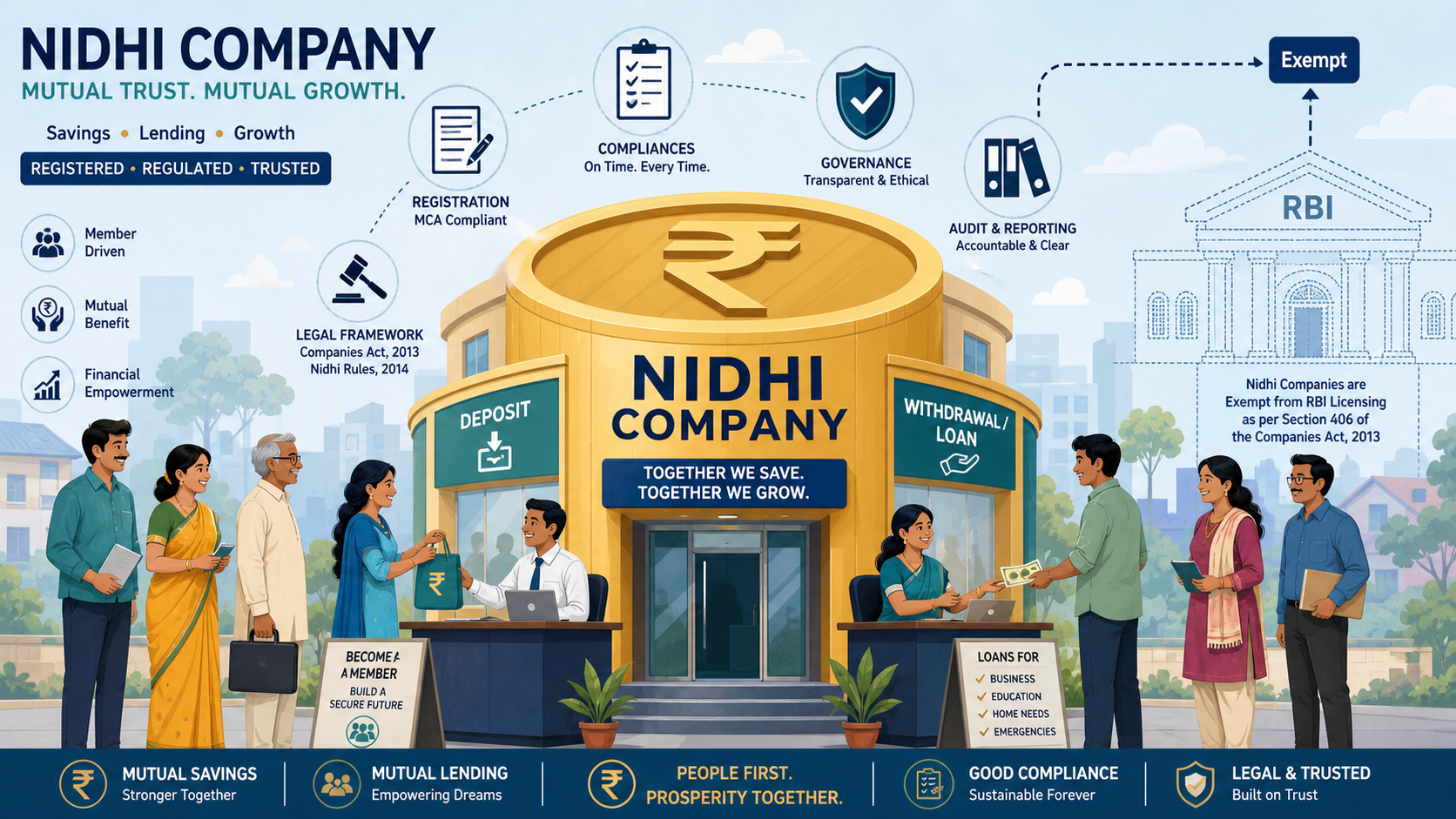
A Nidhi Company is one of the most unique and community-oriented business structures available in India. It operates on a simple principle — encouraging savings among its members and providing loans only to those same members. It is not a bank, it is not a traditional NBFC, and it does not serve the general public. Yet it carries a formal corporate structure, which gives it credibility and a defined legal framework to operate within. For entrepreneurs who want to build a member-based savings and lending organisation, Nidhi Company can be a meaningful and well-structured choice.
Despite this, many founders who consider the Nidhi model are not fully aware of the post-registration obligations, the specific eligibility thresholds to be met within the first year, and what the RBI's position actually means in practice. Understanding all of this before incorporation helps you plan resources, governance, and member acquisition well in advance — rather than scrambling to meet regulatory thresholds after the fact.
What Is a Nidhi Company?
A Nidhi Company is incorporated as a public limited company under Section 406 of the Companies Act, 2013, and is governed by the Nidhi Rules, 2014. Its sole stated object, as recorded in the Memorandum of Association, is to cultivate the habit of thrift and savings among its members, accept deposits from them, and lend money back to those same members — for their mutual benefit. There is no scope to deal with non-members in any financial capacity.
Because all transactions are confined strictly to member-shareholders, the Nidhi model is considered a closed financial ecosystem. This is exactly why the Reserve Bank of India has granted it a special exemption status — it poses significantly lower systemic risk than a conventional NBFC that deals with the public at large. The company name must always end with "Nidhi Limited" and it is registered with the Ministry of Corporate Affairs, not the RBI.
Eligibility and Pre-Registration Requirements
Before filing for incorporation, there are certain foundational conditions that every Nidhi Company must meet. A minimum of seven members is required at the time of incorporation, out of which at least three must be designated as directors. The minimum paid-up equity share capital required at incorporation is Rs. 5 lakhs. Importantly, Nidhi Companies cannot issue preference shares — only equity shares are allowed, and all membership must be of natural persons (no body corporates or trusts can become members, and minors are excluded).
Beyond the incorporation threshold, there are critical post-registration targets that must be met within the first year. The company must grow its membership to at least 200 members, increase its Net Owned Funds (NOF) to a minimum of Rs. 20 lakhs, and maintain the NOF-to-deposit ratio within 1:20. Additionally, at least 10% of total outstanding deposits must be maintained as unencumbered term deposits in a scheduled commercial bank at all times. These are not optional milestones — failure to meet them has direct compliance and legal consequences.
Step-by-Step Registration Process
The registration of a Nidhi Company follows the standard company incorporation route under the Companies Act, 2013, with a few specific additions. The process begins with obtaining Digital Signature Certificates (DSC) and Director Identification Numbers (DIN) for all proposed directors. Once these are in place, a unique name ending in "Nidhi Limited" is submitted to the MCA for approval. The name should reflect the savings and lending nature of the company and comply with MCA naming guidelines.
After name approval, the Memorandum of Association (MoA) and Articles of Association (AoA) are drafted. The MoA must state only one object — the Nidhi purpose as prescribed under the rules — and along with other incorporation documents, it is filed with the Registrar of Companies (ROC) through the MCA portal. The Certificate of Incorporation is typically issued within 15 to 25 days, confirming the CIN. Following this, the company obtains PAN, TAN, and opens a current bank account to begin operations.
RBI Position: Do Nidhi Companies Need RBI Approval?
This is one of the most commonly asked questions about Nidhi Companies, and the answer is clear: No, a Nidhi Company does not require any approval, registration, or licence from the Reserve Bank of India. Although Nidhi Companies technically fall under the broader category of NBFCs, the RBI has specifically exempted them from its core provisions, including the registration requirement under the RBI Act, 1934.
This exemption exists because Nidhi Companies accept deposits and lend exclusively to their own members — not to the general public. The closed-loop nature of their operations significantly reduces the risk of systemic financial harm. Instead of RBI oversight, these companies are regulated directly by the Ministry of Corporate Affairs through the Companies Act, 2013, and the Nidhi Rules, 2014. Founders and clients should be aware, however, that this exemption does not mean freedom from regulation — it simply means a different, MCA-driven regulatory framework applies.
Annual and Periodic Compliances
Once incorporated, a Nidhi Company is subject to a fairly structured set of ongoing compliances. These can be divided into annual filings, half-yearly filings, and event-based compliances. Annual filings include Form NDH-1 (Return of Statutory Compliances, filed within 90 days of the financial year end), Form AOC-4 (Financial Statements, filed within 30 days of AGM), and Form MGT-7 (Annual Return, filed within 60 days of AGM). Director KYC in Form DIR-3 KYC must be completed by September 30 each year, and Income Tax Return in Form ITR-6 must also be filed annually.
On a half-yearly basis, Form NDH-3 must be filed within 30 days of the end of each half-year period — covering April to September and October to March separately. Additionally, Form NDH-4 is used to declare continued compliance with Nidhi Rules, including the 200-member and NOF ratio conditions. Nidhi Companies must also hold at least four board meetings per year, hold an AGM within six months of the financial year-end, and maintain all statutory registers and records properly.
Operational Restrictions You Must Know
Along with compliances, Nidhi Companies are subject to specific operational boundaries that must be factored into your business model from the start. The company cannot open new branches unless it has earned profit after tax (PAT) for three consecutive preceding financial years. Deposits cannot be accepted beyond 20 times the Net Owned Funds. The company cannot advertise for deposits and cannot accept deposits from or lend money to anyone other than its registered members.
Directors of a Nidhi Company must themselves be members of the company and can hold office for a maximum of 10 consecutive years. The statutory auditor's tenure is fixed at five consecutive years, after which rotation is required. These restrictions are designed to keep the Nidhi model true to its purpose — a member-centric thrift institution — and straying outside these limits can attract penalties and regulatory scrutiny from the ROC.
Penalties for Non-Compliance
Non-compliance with Nidhi Rules or the Companies Act provisions applicable to Nidhi Companies is taken seriously by the MCA. A penalty of Rs. 5,000 is applicable for each instance of non-compliance, and if the default continues, a further penalty of Rs. 500 per day is levied until the issue is resolved. Continued or repeated non-compliance can also result in the company being struck off the register or the directors being disqualified.
This makes it particularly important for Nidhi Companies to maintain a structured compliance calendar from day one, rather than treating filings as afterthoughts. The half-yearly NDH-3 requirement, in particular, often catches founders off-guard if they are not properly set up for ongoing compliance from the beginning of operations.
The MACS EDGE Approach to Nidhi Company Advisory
At MACS EDGE, we help clients evaluate whether the Nidhi Company model genuinely suits their objectives before proceeding with registration. The Nidhi framework is specific — it works well for community-based thrift and savings organisations, but it is not a vehicle for general lending, public deposits, or diversified financial services. Making this assessment clearly at the outset saves clients from costly restructuring or compliance failures later.
Our support covers the complete lifecycle of a Nidhi Company — from pre-incorporation advisory and name approval to registration, post-incorporation compliance setup, half-yearly and annual filings, and ongoing governance guidance. Whether you are exploring the Nidhi model for a community savings group, a cooperative-style lending circle, or a structured member organisation, MACS EDGE ensures you enter the framework with full clarity and exit each compliance cycle without penalties or gaps.
Ready to Simplify Your Compliance Journey?
Book a consultation with our experts and get a customized compliance roadmap for your business.