-
 Puregen Labs Meclizine
1 × $$55.00
Puregen Labs Meclizine
1 × $$55.00


Why You Need to Build Business Systems From Day One
May 10, 2026
97 views
If your business stops when you stop, you don't have a business — you have a job. Discover why systems are the foundation of every successful business, with real-world examples from McDonald's, Indian SMEs, and consulting firms.
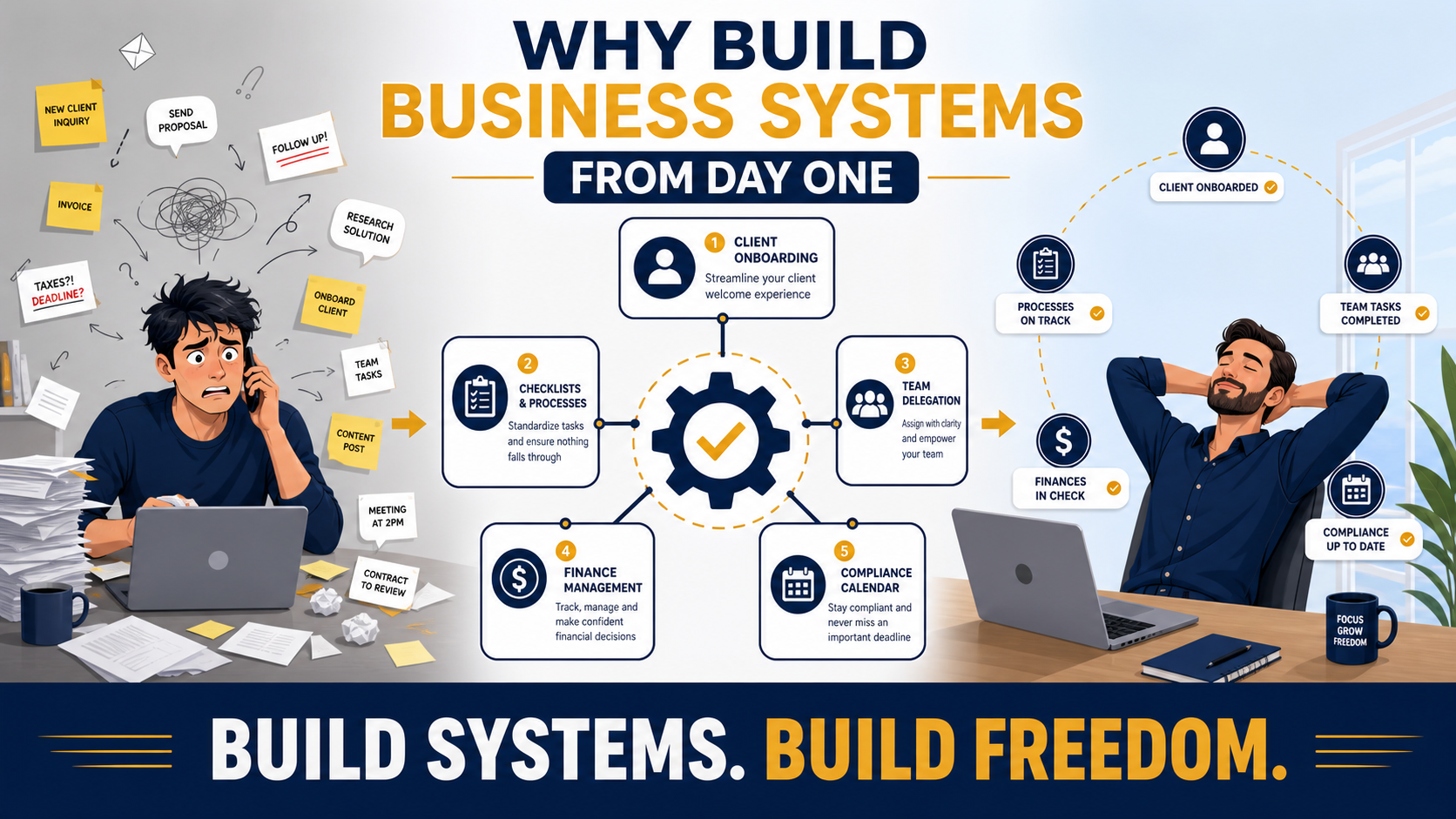
Let me ask you something honestly — if you took a two-week vacation tomorrow and completely switched off your phone, would your business still run smoothly?
For most small business owners in India, the answer is a quiet, uncomfortable no.
And that's not because they aren't talented or hardworking. It's because their business runs on them — not on a system.
This article is about why building business systems from the very beginning — not later, not after you "get established" — is one of the most important decisions you'll ever make as an entrepreneur.
What Is a Business System, Really?
A business system is simply a documented, repeatable process that produces consistent results — regardless of who is doing the work.
It can be:
- A checklist your team follows every time you onboard a new client
- A step-by-step SOP (Standard Operating Procedure) for filing a return or processing an invoice
- An email template that goes out automatically when a client makes a payment
- A workflow that shows exactly who does what, and by when
Think of it as writing the operating manual of your business — one chapter at a time.
"Every frustration in your business is the result of a lack of a system." — Michael E. Gerber, Author of The E-Myth Revisited
The Trap Most Business Owners Fall Into
Here's a story that might sound familiar.
Ravi is a smart, experienced Chartered Accountant. He starts his own practice. Word spreads. Clients love him. Business grows. He hires two assistants.
But within a year, Ravi is more exhausted than ever. Every client calls him directly. Every document needs his signature. Every decision waits for his approval. His assistants sit idle because nothing is written down — it's all in Ravi's head.
This is what business author Michael Gerber calls the "Technician's Trap" — when a skilled professional builds a business around themselves instead of building a business that works without them.
The painful truth? Ravi hasn't built a business. He's built a job — one that owns him.
Why You Must Build Systems From the Beginning
1. Chaos Scales Faster Than You Do
When you have 5 clients, you can manage without systems. But when that number grows to 25 or 50 — without documented processes — the chaos grows faster than your capacity to handle it.
Different team members handle the same task differently. Things fall through the cracks. Clients start getting inconsistent service. And you, the owner, are firefighting every single day instead of growing the business.
Real Example: Imagine a compliance consulting firm that gets 15 new GST registration requests in one month without a documented process. One staff member collects 5 documents, another collects 8, and a third forgets to verify the address proof. The result? Rejections, delays, frustrated clients, and a reputation that takes months to repair.
2. You Become Free to Delegate — and Actually Grow
One of the biggest myths in small business is: "I can't delegate because no one will do it as well as I do."
The truth is — you can't delegate because the process only exists in your head, not on paper.
When you document a system, you hand the document to a team member and they can produce the same result. The system does the thinking. The person follows the steps.
Real Example: A client onboarding process — from collecting KYC documents to sending the welcome email, creating the accounting file, and scheduling the first review call — can be handled entirely by a junior staff member if it's written down with clear steps, responsible persons, and deadlines.
3. The McDonald's Lesson Every Business Owner Needs to Hear
Here's one of the most powerful examples of business systems in history.
McDonald's is not in the burger business. McDonald's is in the systems business.
Ray Kroc scaled McDonald's from one restaurant to over 38,000 locations across 100+ countries — not by hiring 38,000 brilliant chefs, but by building a system so complete and foolproof that anyone could follow it and produce the exact same quality burger, in the exact same time, in any city in the world.
- The exact temperature of the oil for frying
- The precise number of seconds a burger stays on the grill
- The script the cashier uses when you walk up to the counter
- The layout of the kitchen to minimize movement and maximize speed
"The system is the solution." — Ray Kroc, Founder of McDonald's
Now ask yourself — can your clients expect the same experience and quality of service whether you're in office, on a site visit, or on leave?
4. It Protects You in a Crisis
What happens to your business if you fall sick for two weeks? What if a key team member suddenly resigns?
Without systems, the answer is — everything stops.
With systems, the answer is — someone else picks up the SOP and continues.
For a compliance-driven practice where statutory deadlines are non-negotiable, a single missed filing can mean penalties for your client — and loss of trust for you.
Real Example: A TDS return filing SOP with a built-in checklist — challan payment, form preparation, verification, submission, acknowledgement filing — ensures no step is skipped, regardless of who handles the file that week.
5. It Makes Your Business Worth Something
A business that only works because of you has zero resale value. No investor, no buyer, no partner wants to take over a business where the entire value walks out the door every evening.
A business with documented systems, trained teams, and measurable outcomes? That's an asset. That can be valued, sold, franchised, or expanded into new cities.
"Build your business as if you intend to franchise it — even if you never plan to." — Michael E. Gerber
The 7 Core Systems Every Business Needs
You don't need to build everything at once. Start with what hurts the most, then document one system at a time.
- Client Onboarding System — How a new client goes from inquiry to active engagement, with every step defined
- Service Delivery System — SOPs for each service you offer, so quality is consistent every time
- Communication System — Templates for emails, WhatsApp messages, follow-ups, and escalations
- Finance & Billing System — Invoice triggers, payment follow-up sequences, and reconciliation routines
- HR & Team System — Daily task assignments, weekly reviews, and performance checklists
- Marketing System — Content calendar, posting workflow, lead follow-up process
- Compliance Calendar System — A due-date tracker with reminders for all statutory deadlines
How to Start Building Systems Right Now
The biggest mistake people make is thinking that building systems requires a big investment of time or money. It doesn't. Start small and start today.
- Pick ONE task you do repeatedly — say, onboarding a new GST client. Write down every single step, from the first call to the submission of the registration certificate.
- Turn it into a checklist or SOP. A Google Doc or Word file is perfectly fine. The important thing is that it's written down.
- Train one team member to follow that checklist and handle the task from start to finish — without coming to you for every question.
Once that works, document the next task. Then the next. Over time, you'll have a complete operations manual that any new hire can pick up and use.
The Bottom Line
You started your business for freedom — financial freedom, time freedom, the ability to do meaningful work on your own terms. But if your business can't run without you, you haven't built freedom. You've built a more demanding boss than you ever had before.
Systems are what separate a business owner from a self-employed technician. Start building yours today — one checklist, one SOP at a time.
At MACS Edge, we help businesses not just with compliance and registration — but with building the operational backbone that lets you grow without the chaos. Get in touch with us to get started.
Ready to Simplify Your Compliance Journey?
Book a consultation with our experts and get a customized compliance roadmap for your business.